
Farm fence gets picked by what it has to hold. Cattle lean on a fence with their weight, horses hit it at speed, goats find every gap you left, and a boundary along a road does a different job again. The fence that suits one will let another straight through.
Fence types by what you are keeping in
| Fence | Holds | Notes |
|---|---|---|
| Field or woven wire | Cattle, goats, sheep, mixed stock | Graduated mesh, tighter at the bottom. The usual answer for mixed stock. |
| High tensile wire | Cattle, long boundary runs | Cheap over distance. Lives or dies on braced corners. |
| Barbed wire | Cattle, boundary lines | Lowest cost per foot. Keep it out of a horse pasture. |
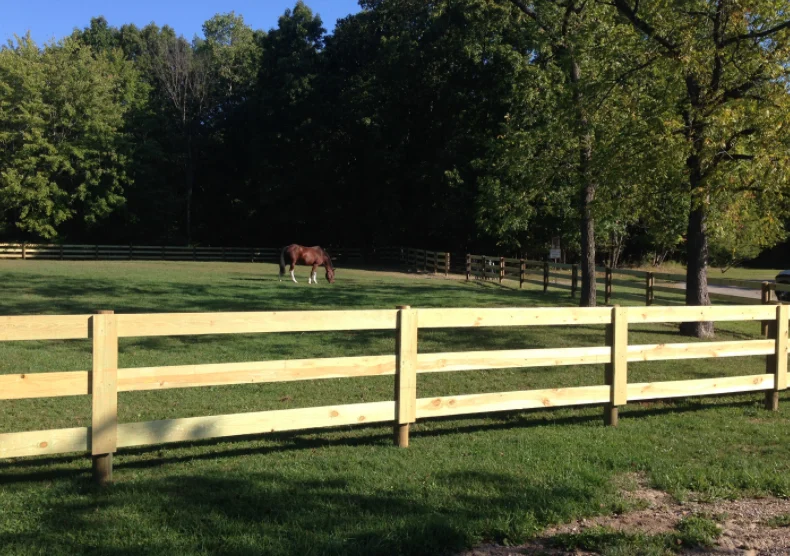
| Board or rail | Horses, road frontage, paddocks | Stock can see it. Costs more and wants upkeep. |
| Rail with mesh backing | Horses, goats, foals | Board visibility with mesh that stops legs and heads going through. |
 WIRE
WIREHorses need a different fence
Horses hurt themselves on fencing more than other stock, which rules out barbed wire in a horse pasture however cheap it looks. A horse who puts a leg through barbed wire and pulls back can do himself serious damage. Do the same on smooth wire or board and he walks away.
Board fence, three rail with mesh backing, and coated high tensile wire all handle horses better. Visibility counts too. A horse has to see a fence to respect it, which is why we run a top board or a sight wire along an otherwise wire fence.
High tensile and why we tension it
High tensile wire carries far more load than soft wire at a smaller diameter, and it holds tension across long runs instead of sagging out over a season. That makes it cheap over distance, which is where it earns its place on acreage.
It lives or dies on corners. Braced corner and end assemblies set deep carry all the tension in the line, and a high tensile fence with weak corners pulls itself apart. The work on a wire fence goes into those corners, not the line posts between them.
Gates sized for equipment
Gate width is the detail people get wrong. A gate that fits a truck will not fit a tractor with a bush hog, a baler, or a trailer that needs a turning line through the opening.
Measure the widest thing you own, add room for the approach angle, and size the opening from that. Twelve feet is common, sixteen is routine for equipment, and anything wider works better as a pair of gates than one heavy leaf that will sag inside two years.
What acreage fencing costs
We quote farm fence by the foot, and over acreage the per foot cost answers to things a yard fence never meets:
- Total distance, and how much of it runs straight against how much turns.
- Terrain, creek crossings, tree lines and rock.
- Clearing, if the line has grown over.
- The number of braced corner and end assemblies, which cost more than the line between them.
- Gate count and gate widths.
- Access for a post driver, and how much of the line goes in by hand.
We walk the line before quoting. On acreage that matters more than it does on a back yard, because one creek crossing or a rock shelf halfway down a run moves the number a long way.